[Previous] -- [Matt's Lego Roller Coaster] -- [Next]
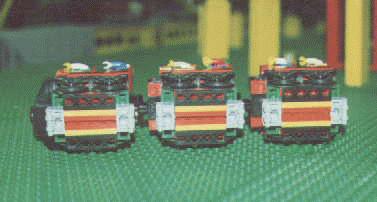
Here is a view of the bottom of the car which was one of the most complex parts of the whole system. The wheels are 9V train wheels, 2 sets per car. I chose the fastest wheel sets in my collection. (I did not use any lubricants or other non-Lego parts of any type above tabletop.) The 9V wheel sets are the most modern 'critical' piece of the whole roller coaster, which means theoretically you could build the whole thing with parts from 1990 and earlier except for the 9V wheels which came out in 1991. They are extremely low friction, unlike any other Lego wheel systems. For the bottom of the cars I used 1x4x1 fence pieces mounted sideways to hold the train onto the track. They are lower friction than any wheel sets I tried, plus they are very flat which is essential around horizontal curves where the clearance between the bottom of the track and the support structure under it is one stud width, or slightly greater than a plate. The fence pieces stick out slightly more than 4 bricks wide. The grey things at either end of each car stick slightly lower than the plane of the fences, and are designed to catch the rubber Technic belts used in certain points on the up hills. The grey things are 1x2 ladder holder plates mounted to face down by sticking their studs into the two side holes on a 1x2 2-hole technic beam (a modern part but probably not 'critical').
[Previous] -- [Matt's Lego Roller Coaster] -- [Next]
| Matt's Lego Creations |